In future, that’s probably where you’ll find my thoughts and reflections on care, while this blog will become more of a site for general updates about my teaching and research.
In my latest Substack post, I reflect on the theme of ‘care and personhood’, as it has emerged from conversations across the first four episodes of the podcast.
The second and third episodes of ‘Careful Thinking‘, my new podcast exploring ideas about care, are now ‘live’ and can be found wherever you get your podcasts.
In Episode 2, I interview Xavier Symons, currently a postdoctoral research fellow in the Human Flourishing Program at Harvard University, about his work on the importance of conscience, and conscientious objection, for healthcare, and also about his writings on dementia care and the role of hospitality in care.
Xavier Symons
Episode 3 features my conversation with Nigel Rapport, emeritus professor of anthropology at St Andrews University, about his notion of ‘cosmopolitan politesse’ and its relevance for thinking about care, and also his proposal that care sometimes requires inaction, rather than action, if it is to respect human individuality.
Nigel Rapport
Listen out for the fourth episode, which should be available in February. As always, you can send feedback on the podcast, or make suggestions for future guests or topics, by emailing carefulthinkingpodcast@gmail.com.
This week I launched a new podcast, Careful Thinking, in which I’m planning to explore ideas about care through conversations with some of the key writers, researchers and practitioners currently working at the cutting edge of care. As I say in the podcast trailer, Careful Thinking is inspired by a passionate belief that thinking critically about care can both deepen our understanding, and improve the day-to-day practice, of care.
The first episode of Careful Thinking, in which I talk with my Open University colleagues Mary Larkin and Manik Deepak-Gopinath about their recent research project on relational care, is now ‘live’ and can be found by following this link , or via Spotify, Apple Podcasts, Amazon, or wherever you get your podcasts.
Mary Larkin
Manik Deepak-Gopinath
I hope you’ll give it a listen – and subscribe to the podcast, so you can be kept up to date with future episodes.
Earlier this year I reported here on a research study that I undertook with my Open University colleagues Kerry Jones and Sam Murphy, exploring men’s experience of belonging to ‘Sands United‘ football teams, set up by and for bereaved fathers. We are in the process of writing up our findings which will be published, among other places, in the book on men and loss that Kerry and I are co-editing and which will appear next year.
As part of the dissemination strategy for the study, Kerry and I recently carried out two podcast interviews with two fathers who have experienced the death of a child in the perinatal period, and who have both been actively involved in organising football teams for other bereaved dads in their local areas. Stephen Doran set up the Cardiff team and Nick Lang organises Sands United Solent in the south of England. The two conversations can be viewed on Youtube.
Image via youtube.com
In the first podcast, Stephen and Nick talk about their experiences of bereavement, as men and as fathers, and the kinds of support that was available, as well as what they would have liked to see in place. The second podcast focuses specifically on Sands United, reflecting on what it is about these initiatives that men find helpful, and how they make it possible men to share their experiences of loss with other men and to support each other in their grief.
Kerry and I are extremely grateful to Stephen and Nick for agreeing to take part in the podcasts and for their openness and honesty in talking about their personal experiences of bereavement. We’ve also been touched by the positive reaction to the podcasts, with people describing the conversations as ‘incredible’ and as offering ‘harrowing but important accounts’. We hope the podcasts contribute to raising awareness of perinatal loss, of the particular experiences of bereaved fathers, and of the kinds of support which are available to men, specifically, in times of bereavement and loss.
Postscript
It’s worth noting that our podcasts aren’t the only place online where you can hear men sharing their stories of baby loss and supporting each other with their grieving. Guys and Grief is a US-based podcast series designed by and for ‘men who have experienced pregnancy and infant loss’. On this side of the pond, ‘Dad Still Standing‘ is a podcast developed by two dads from Essex as a reference point for bereaved fathers, ‘a safe place for them to realise that however hard they’re finding things that they will get through it and find their new normal, and be happy.’ Both podcasts are doing great work and are highly recommended, as is the Bereaved Father account on Twitter/X, whose owner set up the page ‘after losing our daughter during birth…to talk about her, our family and the pain of losing your child.’
In January of this year I welcomed the launch of the new online journal, Fairer Disputations, which describes its mission as advancing ‘a new vision of feminism, one that is grounded in the basic fact that sex is real’. Since then, the journal has gone from strength to strength, aggregating a wide range of articles, videos and podcasts on feminism and women’s rights, gender and the body, sex and exploitation, and work and the family, and also publishing some impressive original essays, including those by its own ‘featured authors’, such as Louise Perry, Mary Harrington and Nina Power. If you want to get a sense of the journal’s overall purpose, and what its editors mean by ‘sex-realist feminism’, I’d recommend reading the essays included in this symposium, and also watching the journal’s launch video.
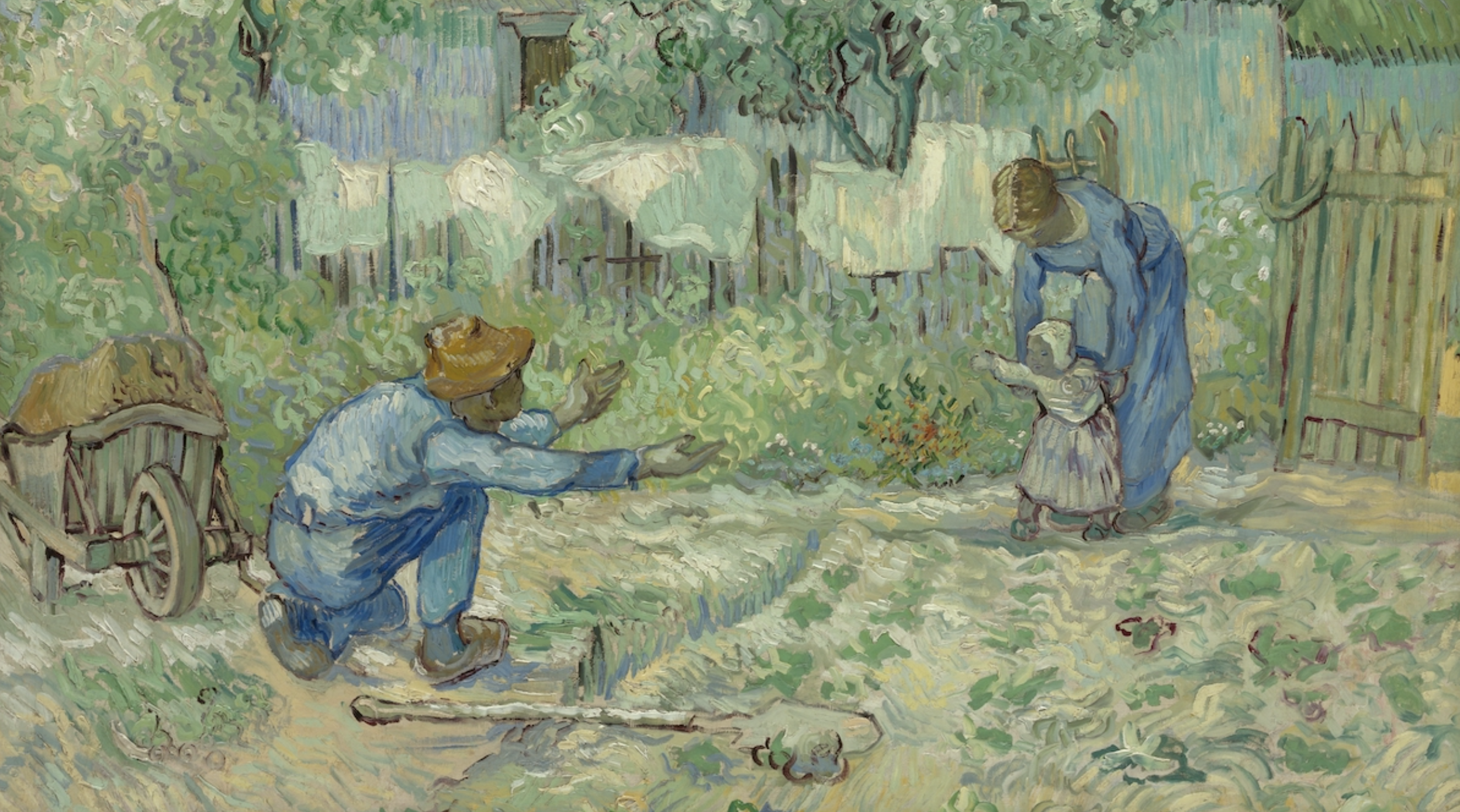
Given my admiration for the journal, I was delighted when the editors agreed to publish my essay, ‘Men’s Care: Same or Different?’ as one of their ‘FD originals’. The article went ‘live’ on the website yesterday, accompanied by a header image featuring Van Gogh’s painting, ‘First Steps’, which beautifully illustrates my thesis about the distinctive and equal contribution of fathers and mothers, and male and female caregivers more generally, to caring for children. (Update: I like this painting so much I’ve now made it my header image).
Readers who have followed the trajectory of my academic research and writing (and there must be one or two out there) may be surprised to see me arguing that there might, after all, be some differences between men’s and women’s modes of caring. I readily admit that my own views on this, and on other issues, have changed over time (see this post). In particular, I no longer find the social constructionist account of gender altogether convincing and have felt increasingly alienated from the relativism and anti-realism that pervades contemporary discussions of identity. In my recent book I attempted to chart a ‘third way’ between what I saw as the inadequacies of both traditionalist essentialism and progressive relativism, when it comes to understanding gender and care, a task that has become more urgent with the rise of the ‘new essentialism’ of gender identity ideology, and its baleful consequences for women’s rights and children’s wellbeing.
My essay at Fairer Disputations is a continuation of this intellectual struggle to reconcile the reality of sex-based differences with a vision of equality between the sexes. As I argue in the piece, one way of moving the debate forward is to focus on the essentially embodied nature of care, which entails recognising that our experience of embodiment is inescapably gendered – or, more accurately, ‘sexed’ – so that there will inevitably be differences between men’s and women’s modes of caring. However, I also argue that this need not entail a deterministic or prescriptive vision of what care by a man, or a woman, will look like:
The precise nature of a man’s care for a child cannot be predicted from his sex, any more than a woman’s can. There will always be individual differences in the way each man or woman expresses his or her embodied, sexed identity, and indeed there will also be similarities between men’s and women’s care, due to their common, embodied humanity.
In contrast to a traditional essentialist approach, which might suggest that women are somehow ‘built’ for care in a way that men or not, I argue that a sex-realist perspective makes it possible to view men’s and women’s caring as inevitably different, but equally valuable. As I write in my concluding paragraph:
An approach rooted in an understanding of the embodied nature of care, and of men and women’s different experiences of embodiment, can provide a framework for understanding both the distinctiveness and the equal importance of men’s and women’s care for children, without the need to resort to rigid stereotypes.
As I also state in the article, there’s more work to be done in working through the full implications of a sex-realist perspective for understanding men’s and women’s caring, and I’ll continue to share my thoughts on this blog as they develop. As always, I’d welcome comments, feedback and even outright disagreement with anything I write!
Earlier this year I was interviewed for the NEON Presents podcast by Zain Yousaf and McKenzie Smith, two young journalism students from Nottingham. The episode was headlined ‘Masculinity in Crisis’ and, among other things, we discussed the vexed question of absent fathers and male role models, gender-based abuse and violence, and changing ideals around what it means to be a man.
Last week saw the publication online of the interactive resource ‘Being a boy’, which I had a hand in developing. The resource can be found on OpenLearn, the Open University’s free learning site, whose stated aim is to ‘break down barriers to education by reaching millions of learners each year, through free educational resources.’ Those resources provide bite-sized learning experiences which offer a taster for The Open University’s main programme of courses and qualifications, while also being complete in themselves. They also constitute a channel for showcasing the university’s research and making it accessible to a broad audience. I’ve contributed to the development of a number of these resources during my time with the university, a full list of which you can find here.
‘Being a boy’ is the third in a series of interactive learning resources on the topic of men and masculinity that we’ve developed over the past year. The ideas for the series originated with colleagues in the OpenLearn team, and it was our faculty media fellow at the time, Mathijs Lucassen, who suggested me for the role of academic consultant on the project. The way the process works is that the designated academic sketches out some content ideas, based on their own and others’ research, and the OpenLearn team then organises that content into a basic structure for the interactive resource. In the case of the masculinity series, we decided to begin each episode with a brief animation, followed by an interactive quiz, and then some pages summarising key research on issues related to the topic. The media company Damn Fine Media was commissioned to develop the animations, for which I wrote the scripts, which were then voiced by the actor Sanjeev Kohli.
Sanjeev Kohli (via imdb.com)
The first resource in the series, titled ‘What makes a good father?’ , was launched to coincide with Fathers’ Day in 2022. The animation posed a series of questions about where shared notions of fatherhood come from, while the quiz asked learners to select what they thought were the key characteristics of a good father, the feedback suggesting how these reflected traditional or modern views of fatherhood. There were no ‘right’ answers to the quiz: the aim was to encourage people to think about how ideas about fathers’ roles have changed over time and how they vary between cultures. The web pages that followed the quiz focused on three key issues surrounding contemporary fatherhood: absent fathers, young dads, and identity and loss, each of them drawing either on research we’ve conducted at The Open University, or on prominent studies from elsewhere.
The second resource in the series, ‘What does it mean, to be a man?’ appeared earlier this year and took a broader focus, exploring changing and diverse notions of masculinity. Once again, the animation posed a number of questions, while the interactive quiz asked learners to select the characteristics they associated with being a ‘real’ man, the feedback indicating whether the qualities selected reflected traditional, modern, or even ‘toxic’ notions of masculinity. Despite the controversy that often surrounds the latter term, I was keen to tackle it head-on and to suggest that, although masculinity is not in itself ‘toxic’ (a common misunderstanding of the term), my own research, particularly with young men, suggests that some aspects of male identity can be harmful to women, and indeed to men themselves. Building on this, the topic pages that followed explored men’s mental health and wellbeing, men’s attitudes to gender equality, and the difficult issue of men, abuse and violence, again drawing on recent research in which I’ve been involved, as well as other landmark studies of these topics.
‘Being a boy’ is the third and final resource in the series, the animation taking as its starting-point the media rhetoric around the so-called ‘problem’ of boys. This time the quiz was slightly different, being a test of learners’ knowledge of some of the key facts about boys’ experiences of issues such as education, health, violence and family relationships. The three linked topic pages that followed focussed on boys and education; role models; and boys, sexism and gender equality. This time, I made more use of work by other researchers and writers, including Richard Reeves’ important book Of Boys and Men, which I wrote about in this post.
This latest resource is the one I’m happiest with. It took me a while to get used to the novel way of working that producing this kind of interactive resource entails. I was worried to begin with about the danger of simplifying the findings from research, or giving the impression that there are straightforward answers to the questions we were posing. I also became more confident, as time went on, about suggesting improvements, or highlighting things with which I wasn’t completely happy. Looking back on the first two episodes in the series, I’d certainly want to do a number of things differently now. In the case of ‘Boys will be boys’, I think we got the tone about right and mostly resisted falling into simplistic representations of the issues. Even so, at least one Twitter user has already responded critically to the animation, suggesting that it denies the important role that fathers play in boys’ lives: in fact, the video simply poses the question as to whether positive male role models are essential for boys’ wellbeing. The purpose, once again, is to encourage learners to challenge their own thinking and to consider all the evidence before making up their minds.
Despite my concerns about over-simplification, I believe that interactive resources of this kind can play a useful role, opening up bodies of knowledge and ways of understanding to those who are usually denied access to them, encouraging people to reflect critically on their own beliefs and why they hold them, at the same time hopefully promoting a more nuanced and informed debate about contentious issues such as masculinity, identity and equality.
With my Open University colleagues Kerry Jones and Sam Murphy, I recently carried out a study of the experiences of men who joined football teams for fathers who have lost a child through stillbirth or neonatal death. Supported by SANDS, the UK’s leading neonatal death charity, a number of ‘SANDS United‘ teams have sprung up across the UK in the past five years or so. Key features of these initiatives have been that they are organised by bereaved fathers themselves; that they offer men an opportunity to honour their children’s memory, for example through displaying their names on their football shirts; and that they provide fathers with different avenues for finding support and for sharing their stories with others who have had similar experiences, for example through touchline conversations, social events and WhatsApp groups. You can watch a video (with specially-composed music by Lewis Capaldi) about Rob Allen, who founded the first SANDS United team in Northampton in 2017, here.
As a researcher interested in fatherhood, masculinity and care, I was particularly keen to explore how this kind of shared physical and social activity could provide a way of reaching men who find conventional forms of support and talk-based therapies either inaccessible or inappropriate to their needs. We know that many fathers are deterred from seeking help by social expectations that men should respond to bereavement by being stoical and resilient and getting on with life, while others have been conditioned to see a man’s primary role in such circumstances as being to support his partner, rather than acknowledging his own feelings of grief. I was also intrigued by the men’s need, repeatedly emphasised in the interviews we carried out, to have their children’s brief existence acknowledged by others and to hear their children’s names spoken: to me, this also reflected a broader need to have their own identities as fathers affirmed, when the pressure from the wider society is often to forget, and to move on.
Earlier today, I gave a presentation on the initial findings from our study to the Children, Young People and Families Research Group at The Open University, and I’ve attached my Powerpoint slides from the presentation below:
Kerry, Sam and I are planning to publish our findings in a chapter in the book that Kerry and I are editing on men and loss, which is due out next year, as well as disseminating our research through journal articles, blogs and podcasts. With our colleague Alison Davies, we’ve already published a scoping review of existing research on men and perinatal loss, highlighting the need for further work to understand men’s distinctive experiences of bereavement and their specific needs for support.
References
Jones, K., Robb, M., Murphy, S. and Davies, A. (2019) ‘New understandings of fathers’ experiences of grief and loss following stillbirth and neonatal death: a scoping review’, Midwifery, 79, pp. 102531–102531
Jones, K. and Robb, M. (eds.) (forthcoming, 2024) Men and Loss: Masculinity, Bereavement and Grief (working title), London: Routledge
I’ve recorded a video tutorial for Sage Research Methods, on ‘researching sensitive issues with men’. The video is now live on the Sage website. You’ll need to subscribe to watch the whole thing, which lasts about 20 minutes, but you can view a brief preview, and get a sense of the main issues covered by the video, here. I’m waiting for Sage to send me a longer clip that I can post as a taster.
Sage Research Methods is a website run by the academic publisher of the same name, aiming to support research by providing material to guide users through every step of the research process. As the website states:
Nearly everyone at a university is involved in research, from students learning how to conduct research to faculty conducting research for publication to librarians delivering research skills training and doing research on the efficacy of library services. Sage Research Methods has the answer for each of these user groups, from a quick dictionary definition, a case study example from a researcher in the field, a downloadable teaching dataset, a full-text title from the Quantitative Applications in the Social Sciences series, or a video tutorial showing research in action.
[The article] reflects on my personal experience, as a male researcher, of discussing gender identity and relationships with young male participants. Using examples from two of the research studies in which I’ve been involved, the article argues that the nature of masculine identities, and the way that masculinity ‘works’ in the research process, mean that research with young men on issues of this kind is always inherently sensitive and brings with it considerable challenges for researchers.
Adopting a psychosocial approach to issues of gender identity, and to conceptualising the research process, I also contend that it’s important to understand the research encounter as an intersubjective process in which the identities of both researcher and researched influence each other in dynamic though often hidden ways. The article discusses these challenges in detail and makes some practical suggestions as to how researchers might respond to them.
I drew on some of this material in my video tutorial for Sage, though I widened the scope to discuss research with men generally, rather than just young men.
Screenshot via methods.sagepub.com
The process of recording the video was interesting. At the time (June 2022), Sage were still working mostly online and asked me to record the video at home, rather than in the studio. This entailed sending me some simple recording equipment and, on the day, connecting with me online to provide instructions. I had to record the video on my phone and then send a copy to the Sage recording engineers, who checked it for sound and vision quality. We had to do a few ‘takes’: as you’ll see if you watch the final product, I found it difficult to simultaneously refer to my approved script (I’m not capable of doing a twenty-minute recorded talk from memory – at least, not one that will be viewed potentially by hundreds of people) and at the same time maintain eye contact with an imagined viewer.
I think the final product is OK. I hope the video will be useful to other researchers who are thinking about exploring sensitive issues of gender, identity and relationships, with men.
One of the main findings of my research with men who care, whether as ‘hands on’ fathers or paid care workers, has been that an early experience of caring for others can be instrumental in the development of a capacity to care. As I wrote in my book, Men, Masculinities and the Care of Children: Images, Ideas and Identities, ‘the actual experience of caring for another person can be transformative for boys and men, with early opportunities to care for family members often contributing to a decision to work in the care field’. And in an earlier post on this blog, I noted: ‘In my research with men who care professionally for children, I’ve often been struck by the influence of childhood or teenage experiences on their decision as adults to engage in care work. In many cases, it seems to have been an early experience of caring for a child – babysitting younger siblings, for example, or being offered a work experience placement in a nursery – that was a key influence in their later choice of career.’ In the same post, I commented that these experiences are still comparatively rare for most boys, and I wondered whether ‘if more boys were involved in hands on care for others from an early age there [would] be more men coming forward to work in the caring professions, or more fathers willing and capable of taking a full and equal role in the care of their young children?’
Image via proudtocarehull.co.uk
With this in mind, I was interested this week to read a new article by Leah Libresco Sargeant (see this post), in which she proposes that teenage boys should be encouraged to care for the elderly. Sargeant approaches the subject at a slightly different angle from me, prompted initially by a concern about a growing divide between the generations:
There’s a deep poverty in age-segregated societies. It is especially pronounced in high school and college, when teens and twenty-somethings are often siloed off from older people, even those in their own families.
She notes that ‘one of the most delightful ways to shatter age silos’ to emerge in recent years has been the practice of co-locating nursery schools with nursing homes, of which there are a growing number of examples. As Sargeant comments: ‘Both seniors and toddlers move unsteadily through a world built for the capacities of able-bodied adults. Both ages are more willing to sit in contemplation while the “productive” world hurries by.’ You can read about the first such intergenerational facility in the UK here, and get an insight into its daily practice by watching this inspirational video.
Sargeant’s proposal is that this initiative in crossing the generational divide should be extended to involve teenage boys in caring for the elderly:
More elder care should be taken on by teenaged boys. Aging seniors often need physical support, which may go beyond what their adult children and caretakers can provide. Teen boys need to be needed, and they need examples of how they can grow into someone that others can depend on.
Sargeant’s argument is motivated perhaps less by a desire to develop boys’ capacity to care and more by the need to find an outlet for young male energy, which she portrays in what some might think is a mildly stereotypical manner:
For teen boys, adolescence is a time of growing into strength without necessarily knowing what to do with it. Team sports are a way to blow off energy and grow into brotherhood; shop class can be a way to learn to make a mark on the world. But it’s hard for young men to get experience with the other purpose of their strength — to be a support to someone weaker than themselves.
Personally speaking, team sports were never my thing – I was more likely to ‘blow off energy’ and bond with friends through rock music – and as for ‘shop class’, which those of us who grew up in the UK knew as woodwork and metalwork, it was the bane of my school years, just as my wife now looks back with horror on her compulsory ‘domestic science’ classes. However, Sargeant’s general point is well taken.
Sargeant is closer to my own concern with the development of boys’ capacity to care, when she suggests that an early experience of caring for younger children can help young men to acquire the skills and aptitudes that they will one day need as fathers:
Teen boys are less likely than girls to sign up as babysitters, and even less likely to be hired. When a young man takes an interest in children, he’s more often met with suspicion than with praise for his desire to develop the virtues he’ll need as a father.
As I wrote in my earlier post on this topic, since care is a fundamentally embodied practice, then as well as encouraging boys to think that caring is something they might like to do, and be capable of, these early experience of ‘hands-on’ caring can actually develop what I described as ‘an early bodily habituation to care’ – a ‘muscle memory’ for caring, if you like. However, in addition, Sargeant is surely also right to view caring for others as an important part of boys’ moral education as future men:
Caring for the weak is good formation for young males who hope to grow up to be depended on as men. It gives them a chance to take pride in their distinctive, masculine gifts, while also seeing that they receive these gifts in order to offer them to others.
Men and women have both been unsexed in the name of equality. The injustice done to women is more blatant…But for men, there’s also been an unsexing. A man who is just told not to abandon his child has not been called to the fullness of fatherhood. The emphasis on breadwinning similarly reduces a father to a generic parent (or worse, a mere payroll deposit).
A woman’s motherhood is more starkly physical; a baby’s demands during gestation and nursing are undeniable (despite our culture’s efforts to escape them). For men to participate in a sex-realist, pro-family movement, we have to articulate what is distinctive about men and their capacity for fatherhood.
In my own experience, the Bradley approach to labor and childbirth was profoundly engaged with dignity in asymmetry. Only I could labor to bring our daughters into the world, but my husband was no passive observer (and he certainly wasn’t out in the lounge with cigars). I depended on him more than our midwives or our doula—to take my weight during contractions, to speak for me during consults for interventions, and to be prepared to hold our baby first when I was immobilized by a c-section.
I look for that model of complementary strengths and dependencies outside of the labor and delivery ward. Mothers and fathers both need space outside of being generic “workers” to give themselves to their families and communities in their own distinctive ways.









 Martin Robb